NaPro Doctors vs. a Catholic Functional Fertility Dietitian: What’s the Difference & Do You Need Both?
If you're navigating the fertility world through a Catholic lens, you've likely encountered two terms: Creighton Model FertilityCare System and NaProTechnology.
Here's the thing: they're related, but they are not the same. And the distinction does matter.
Creighton vs. NaPro: The Quick Version
A Creighton practitioner teaches you how to chart your cycle—tracking cervical mucus, basal body temperature, and other biomarkers to understand when you ovulate (and when you're most fertile). It's data collection.
A NaPro doctor is a physician (usually an OB-GYN or family medicine doctor with additional training) who uses that charting data clinically. They take your Creighton chart, order cycle-timed labs, perform imaging and diagnostics, and prescribe medical treatment.
Think of it like this:
Creighton practitioner = gathers the data
NaPro doctor = uses the data clinically
Both approaches align with Catholic teaching on fertility and natural methods. But they're doing fundamentally different things.
What a NaPro Doctor Actually Does
A NaPro physician has a specific medical lens: "What reproductive dysfunction can I diagnose and medically treat while working with natural fertility?"
They commonly evaluate five key areas.
1. Ovulation Quality
The first question is simple: Are you actually ovulating? But it goes deeper.
Is ovulation happening on time, or delayed?
Is follicle growth normal?
Is your corpus luteum (the progesterone-producing structure after ovulation) working well?
They may order:
Serial progesterone measurements
Estradiol testing
Ultrasound follicle tracking timed to your cycle
Example: You're ovulating regularly, but your progesterone crashes by day 21. The NaPro doctor might diagnose a luteal phase defect or poor corpus luteum function. Treatment could include progesterone support, hCG injections post-ovulation, or ovulation support medications like Letrozole (femara).
One thing NaPro is known for—and frankly, what makes it different from conventional fertility care—is timing labs around your actual biological cycle, not arbitrary calendar days. Because let’s be real, most women do not ovulate on cycle day 14 nor have a 28 day cycle.
2. Hormone Deficiencies
They investigate:
Low progesterone
Low estrogen
Thyroid dysfunction
Elevated prolactin
Androgen excess or PCOS (now named PMOS)
Again, the cycle-timed testing is key here. Most conventional doctors test on day 3, no matter what. A NaPro doctor times labs to your cycle.
3. Structural Problems
Blocked fallopian tubes, uterine polyps, fibroids, adhesions, endometriosis, ovarian cysts—NaPro doctors take these seriously and investigate thoroughly.
Common diagnostics include:
Ultrasound
HSG (hysterosalpingogram)
Laparoscopy
Hysteroscopy
Many NaPro physicians are particularly thorough about finding subtle endometriosis, sometimes recommending excision surgery to remove it.
4. Recurrent Miscarriage
If you've had multiple losses, a NaPro doctor may evaluate:
Progesterone insufficiency
Clotting disorders
Autoimmune issues
Thyroid autoimmunity
Male factor
Chromosomal concerns
They may order a thrombophilia panel, autoimmune labs, and hormone support—a workup that often goes deeper than conventional care.
5. Male Factor
Doctors should assess the partner too. They may order:
Semen analysis
Hormone testing
Varicocele evaluation
Sperm DNA fragmentation testing
Male factor is involved in a significant portion of fertility cases, and it shouldn't be overlooked.
Here's Where It Gets Interesting: The Question I Ask as a Catholic Fertility Dietitian
A NaPro doctor asks: What diagnosis can I make, and what medical treatment is indicated to support this woman/couple?
Examples: endometriosis, PCOS, luteal defect, tubal blockage, recurrent miscarriage. Treatment might be surgery, medication, hormone replacement, or imaging.
This is important.
As a Catholic fertility dietitian, I ask something different: Why is your physiology not functioning well in the first place?
When you're ovulating but not getting pregnant, or when progesterone is low, my lens—informed by nutrition science and metabolic health—shifts to root causes.
Whyis your progesterone low?
Are you eating enough calories?
Is your cholesterol adequate?
Do you have chronic inflammation?
What's your magnesium status?
Do you have insulin resistance?
Is your circadian rhythm disrupted?
How's your gut health?
That investigative depth—grounded in nutrition science, functional care, and our Catholic values around healing isn’t typically where physicians go.
A Real Example
Let's say you have:
Regular, predictable cycles
Confirmed ovulation
12+ months without pregnancy
What a NaPro doctor might find:
Mild endometriosis
Low luteal progesterone
Slight thyroid dysfunction
Treatment: Surgery, progesterone, thyroid medication. Helpful, and legitimate!
What I might additionally uncover as your Catholic fertility dietitian:
You're eating 1,500 calories while training 6 days a week
Fasting insulin of 10 (signaling metabolic stress)
A1c of 5.7 (prediabetic range)
Ferritin of 22 (low-normal, not optimal)
Vitamin D of 30 (deficient)
Poor sleep quality
Chronic sympathetic dominance (stuck in fight-or-flight)
Gut dysbiosis or hidden inflammation
All things that can impact your hormones and ability to conceive.
This explains why the terrain is suboptimal. It explains why your body isn't conceiving, even though technically you're ovulating. And more importantly, it points to what you can actually change through nutrition, metabolic support, and lifestyle—not just what medical interventions can address.
NaPro Care does not = functional fertility care
Let me be clear: NaPro doctors are excellent and genuinely root-cause oriented. I respect their work immensely, however, many still practice fairly conventional medicine alongside a Catholic framework.
That means they may stop at:
"Progesterone is low → take progesterone"
"Not ovulating → take Letrozole"
"TSH is high → take Levothyroxine"
That can help and may help couples conceive! But it does not address:
Nutrition adequacy (calories, protein, micronutrients)
Mineral status (iron, zinc, magnesium, selenium)
Blood sugar patterns and metabolic health
Gut health and nutrient absorption
Oral microbiome (yes, it matters for fertility)
Toxin load and phase 1/2 detoxification
Nervous system regulation and chronic stress
That gap—that's exactly where I work.
How Do Napro Care & Functional Nutrition Work Together?
The best fertility outcomes I see happen when both are involved.
A NaPro doctor diagnoses structural issues or autoimmune disease and treats them medically. That's essential. Don't skip it.
As a Catholic fertility dietitian, I optimize the terrain underneath. I make sure your body has the nutrition, metabolic flexibility, nervous system capacity, and lifestyle foundations to not just conceive naturally but also sustain a healthy pregnancy and support a couple’s long-term health. Because if something is going on before pregnancy, it does not just go away when conception occurs. In fact, many pre-pregnancy issues such as blood sugar dysregulation, inflammation, thyroid dysfunction, or low nutrient levels may get worse during such an energy demanding time that is pregnancy and postpartum.
Doctors do not replace functional dietitians and functional dietitians do not replace doctors..
Where To Start with Catholic Fertility?
If you're exploring fertility and Catholic-aligned care:
Learn your cycle. This gives you—and any doctor you work with—real data. This is something we cover inside our 1:1 work with clients because we want every single woman to understand how to interpret their cycle and understand what their body is doing. Your monthly cycle is a report card on your overall health and fertility.
Consider a NaPro doctor if you have irregular cycles, aren't ovulating, have had miscarriages, or have been trying for 6+ months without success, it is so important to rule out structural issues, endometriosis, PCOS/PMOS, etc.
Work with a us to optimize your nutritional status, metabolic health, and lifestyle factors by looking at the body holistically regardless of your medical diagnosis. I walk you through how to support your body in functioning the way it was designed to vs bypassing issues and taking a band-aid about to fertility.
You do not have to choose one over the other. Several of our clients work with a Napro doctor while doing the work to address deeper root-causes through our functional fertility framework.
Fertility is not just about getting pregnant, it’s about supporting your overall current and future health for you and your baby.
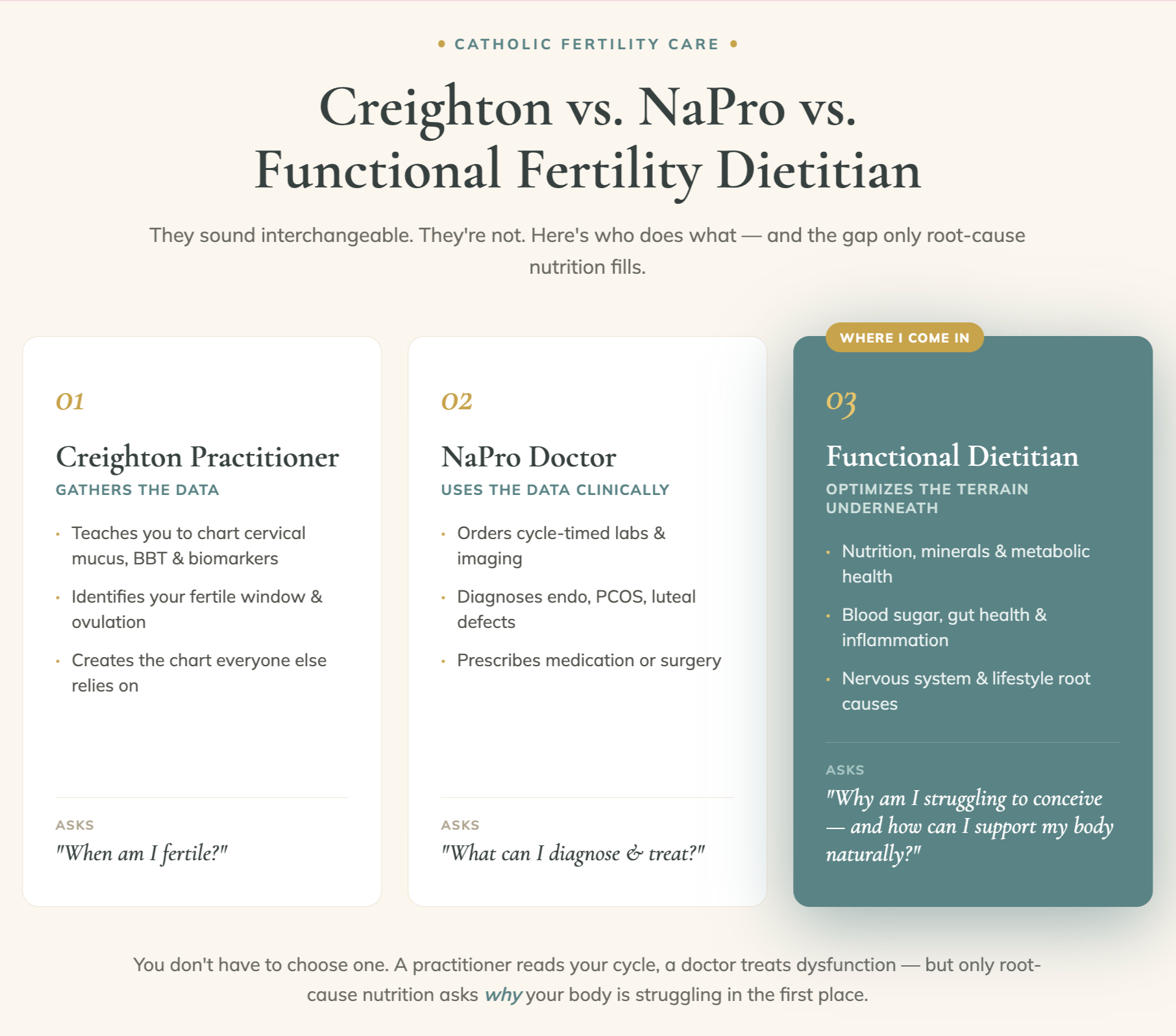
Let’s summarize!
A Creighton practitioner teaches you how to read your cycle.
A NaPro doctor diagnoses and medically treats reproductive dysfunction.
As a Catholic fertility dietitian, I help optimize the underlying terrain—nutrition, metabolism, inflammation, minerals, and lifestyle—so your body can have symptomless, regular cycles, better digestion, improved mood, better sleep, and are able to conceive naturally and go on to sustain a healthy pregnancy and postpartum.
All three approaches have a place. And together, they create a more complete picture of what your fertility needs.
If you're curious about what root causes might be hiding beneath your diagnosis, I created a free guide specifically for Catholic women navigating unexplained infertility. It walks through some of the exact labs I recommend to get to the root-cause of your “unexplained infertility”.
Get A Catholic Woman's Guide to 'Unexplained' Infertility
You deserve to feel supported in every way and have the best chance at conceiving in a way that aligns with your values.
Curious about root-cause functional fertility care with our team? Learn more and apply here